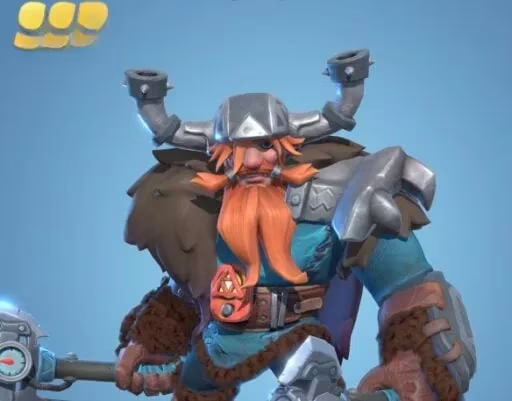
The frozen winds of 2026 howled through the ruined cities of Whiteout Survival, but Commander Max barely noticed the chill. His gaze was fixed on the hero recruitment screen, where a new figure loomed: Magnus, the armored titan rumored to turn the tide in both exploration and expedition battles. Max had saved every skill manual and scrap of upgrade ore for this moment. Yet, as any veteran survivor knew, simply unlocking a hero wasn't enough. To truly thrive in the wasteland, you had to build them with surgical precision—especially when resources were scarcer than a heat spring in a blizzard.
Max recalled the advice that echoed through the shattered radio towers: not all skills carry equal weight. Leveling a skill from 1 to 2 cost the same manuals as going from 9 to 10, but the diminishing returns bit hard. A single misstep could waste dozens of universal manuals, leaving other heroes underpowered. So, instead of blindly tapping the upgrade button, he consulted the encrypted data logs on Magnus’s combat algorithms—what seasoned players called the “fine-tuning” method.

The first revelation was the stark divide between Exploration and Expedition skills. Magnus’s kit demanded a careful balance: too much emphasis on arena-style Exploration skills, and he’d falter in the massive expedition battles that defined alliance wars. Max started by unlocking Magnus’s core area-damage ability, a devastating shockwave that survivors nicknamed “Frostbreak.” According to the optimization logs, this skill—Magnus’s second Exploration slot—provided the biggest immediate power spike. He pushed it to level one, then immediately gave it a second point, bringing it to a sweet spot where the damage increase was still massive relative to the manual cost.

Next came the expedition side. Max navigated to the first Expedition skill, a defensive aura called “Bastion of the Ancients,” which buffed all infantry troops’ health. Instead of raising it immediately, he waited. The reason was simple: early game expedition matchups rarely demanded high-level defensive layers. He first mustered enough shards to promote Magnus’s star rank, which automatically unlocked the skill. Only then did he invest one level into Bastion, followed by a second. This staggered approach meant that every manual spent directly contributed to making Magnus viable in the current meta without over-committing.

With the skill order firmly in his mind, Max turned to the second half of the optimization puzzle: gear. At his account’s stage—freshly entering the Mythic-tier era—crafting a full set of high-rarity equipment was a fantasy. The real art lay in finding the value thresholds where each piece of gear delivered the most stats per upgrade ore invested. Spreading ore evenly across goggles, gloves, belt, and boots was a rookie mistake; you had to know which armor slots gave the most attack, health, or lethality for your hero’s role.
Max studied the gear sweetspot guide. For a tanky infantry hero like Magnus, the priority was clear: gloves and belt took precedence. He forged a set of Infantry Epic Gloves and immediately pushed them to level 80. The leap in health and defense at that threshold was colossal. The Infantry Epic Belt followed suit, also reaching level 80, fortifying Magnus’s ability to soak enemy frontal assaults. For goggles and boots, however, the returns softened after level 63. Max stopped there, saving thousands of precious upgrade ores for other heroes. As for the exclusive weapon, the Storm Axe, he left it at a modest level 6—more than enough for its base effects without draining the rare weapon polymers needed for later evolutions.
When the next Chief Championship battle arrived, the difference was night and day. Max’s Magnus, despite not being fully maxed out in every category, punched far above his weight class. The carefully leveled Frostbreak skill shredded backline defenders in exploration mode, while the Bastion aura kept his infantry line standing in expeditions against opponents who had dumped manuals into inferior skills. The gear investment, laser-focused on the high-impact slots, meant Magnus could trade blows with heroes backed by far more total resources.
Word spread through Max’s alliance. “How does your Magnus have 15% more effective health than mine? We have the same hero rank!” a confused ally asked. The answer was always the same: fighting the urge to spend everything at once. By trusting the diminishing-return curves and the detailed skill unlock sequences, Max had saved roughly 30% of the universal manuals and upgrade ore that a mindless build would have consumed. Those resources fed into secondary heroes like Sergey and Bahiti, snowballing his account progress across the board.
As Max looked out over his now-thriving settlement, he reflected on the lesson Magnus had taught him: in the brutal arithmetic of Whiteout Survival, brilliance belongs not to the biggest spenders, but to the sharpest planners. A hero is not a dump for your manuals—it is an elegant equation, and solving it brings a satisfaction no amount of raw power can match. The frozen wastes still held countless threats, but with his lean, viciously efficient Magnus leading the charge, Commander Max felt ready for whatever 2026 threw at him next.